
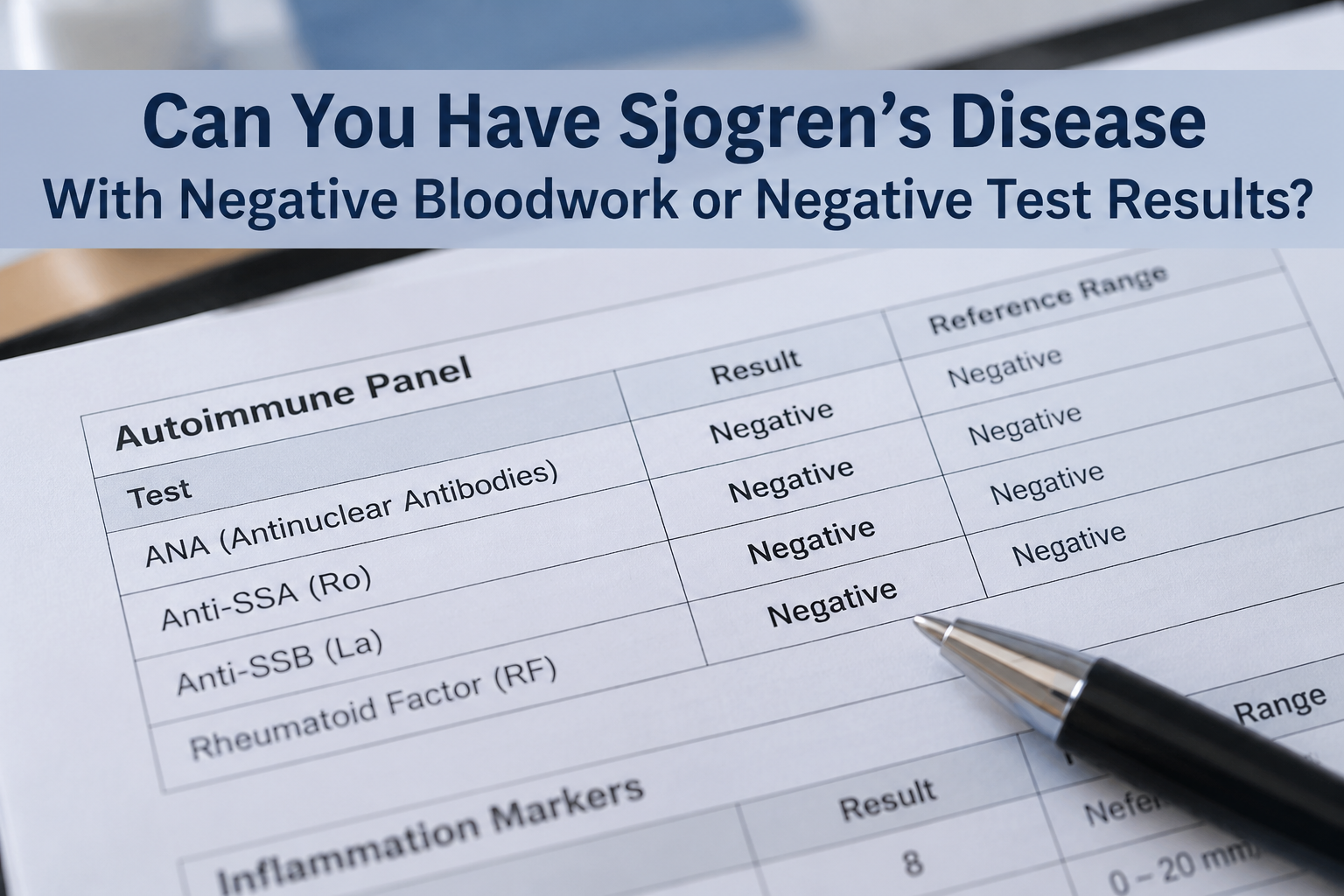
Can You Have Sjogren’s Disease With Negative Bloodwork or Negative Test Results?
You’ve been experiencing symptoms that aren’t going away.
Maybe it’s dry eyes, dry mouth, overwhelming fatigue, joint pain, or unexplained nerve sensations.
Your doctor orders bloodwork to check for Sjogren’s disease. The results come back negative. But you’re still experiencing the same symptoms.
Can you have Sjogren’s disease even when your bloodwork is negative? What if your other tests are negative, too?
Yes, it’s possible. But there’s an important difference between negative antibody testing and having several different tests that show no evidence of Sjogren’s disease. Understanding that difference can help you make sense of your results and determine what questions to ask next.
Can You Have Sjogren’s Disease With Negative Bloodwork?
Yes. Some people with Sjogren’s disease do not have detectable anti-SSA/Ro antibodies, one of the antibodies most closely associated with the condition. This is commonly referred to as seronegative Sjogren’s disease.
Estimates vary depending on the population studied and how researchers define seronegativity. Approximately 30–40% of people with Sjogren’s may test negative for anti-SSA/Ro antibodies.
However, negative antibodies do not establish a diagnosis of seronegative Sjogren’s. They are simply one part of the evaluation. Your rheumatologist must also consider your symptoms, medical history, examination findings, and other possible explanations.
Which blood tests are used?
Anti-SSA/Ro: One of the most important antibodies associated with Sjogren’s. A positive result provides significant supporting evidence, but not everyone with the disease tests positive.
Anti-SSB/La: May be present alongside anti-SSA/Ro. However, isolated anti-SSB/La positivity does not contribute points toward the 2016 ACR/EULAR classification criteria.
ANA (antinuclear antibodies): Can indicate autoimmune activity but is not specific to Sjogren’s. A negative ANA does not exclude the disease.
Rheumatoid factor (RF): May be elevated in Sjogren’s and other autoimmune conditions but cannot establish the diagnosis independently.
Your doctor may also order additional laboratory tests to evaluate inflammation, organ function, associated abnormalities, or alternative diagnoses. The British Society for Rheumatology recommends considering extractable nuclear antigen (ENA) testing when suspicion for Sjogren’s remains high, even if ANA testing is negative.
The key is understanding that antibody testing does not directly measure tear production, saliva production, or inflammation within the salivary glands. That’s why additional evaluation may sometimes be appropriate.
Can You Have Sjogren’s Disease With a Normal Schirmer Test?
The Schirmer test measures tear production using a small strip of paper placed near the lower eyelid. However, dry eye disease involves more than tear production alone.
Someone may experience significant eye discomfort because their tears evaporate too quickly or because their tear film is unstable. Meibomian gland dysfunction, for example, can contribute to dryness and irritation even when tear production is relatively preserved.
An eye specialist may also evaluate ocular surface staining, tear-film stability, and meibomian gland function. These findings help identify what may be contributing to your symptoms.
If you’re experiencing persistent eye discomfort despite normal Schirmer results, ask whether a more comprehensive dry eye evaluation would be appropriate.
What If Your Lip Biopsy Is Negative?
A minor salivary gland biopsy, commonly called a lip biopsy, examines small salivary glands for a characteristic pattern of inflammation. It can be particularly useful when Sjogren’s antibodies are negative.
However, biopsy results can be influenced by the amount of tissue collected, how inflammation is distributed, and how the sample is interpreted. A negative biopsy reduces the evidence supporting Sjogren’s disease, but it does not exclude the condition with absolute certainty.
If your biopsy findings seem inconsistent with your clinical picture, you can ask whether the sample was adequate and whether an experienced pathologist reviewed it. That does not automatically mean another biopsy is needed.
Before undergoing a biopsy or considering additional testing, ask: “How would this result change my diagnosis, treatment, monitoring, or next steps?” Understanding what the procedure is expected to accomplish can help you make an informed decision with your healthcare team.
Can Salivary Gland Ultrasound Help?
Salivary gland ultrasound uses sound waves to examine the major salivary glands, including the parotid and submandibular glands. Certain structural changes may support a diagnosis of Sjogren’s disease.
The British Society for Rheumatology recognizes ultrasound as a useful additional diagnostic tool, particularly when antibody testing is negative. However, ultrasound is not included in the 2016 ACR/EULAR classification criteria, and a normal examination does not independently exclude the disease.
Not every rheumatologist has specialized training in performing or interpreting salivary gland ultrasound for Sjogren’s evaluation. If ultrasound is being considered, ask whether someone experienced in this type of examination is available.
What If All Your Sjogren’s Tests Are Negative?
Having negative bloodwork is different from having negative bloodwork combined with normal objective eye testing, normal salivary flow testing, and negative findings from other appropriate investigations. When several properly performed tests show no evidence of Sjogren’s disease, the overall evidence supporting that diagnosis becomes weaker.
At that point, considering other explanations becomes especially important. Dryness, fatigue, joint pain, and neurological symptoms can occur with thyroid disorders, medication effects, other autoimmune conditions, sleep disorders, and numerous other medical problems. Sometimes more than one condition is contributing to your symptoms.
The goal isn’t to make every symptom fit Sjogren’s disease. It’s to understand what’s happening and identify appropriate care.
Classification Criteria Are Not the Same as a Clinical Diagnosis
One commonly misunderstood aspect of Sjogren’s evaluation is the difference between classification criteria and clinical diagnosis. The 2016 ACR/EULAR classification criteria were developed primarily to identify consistent patient populations for research. They use a weighted scoring system based on five objective findings.
|
Finding |
Points |
|
Positive anti-SSA/Ro antibodies |
3 |
|
Minor salivary gland biopsy showing characteristic inflammation with a focus score of at least 1 per 4 mm² |
3 |
|
Ocular staining score of at least 5, or van Bijsterveld score of at least 4, in at least one eye |
1 |
|
Schirmer test of 5 mm or less in 5 minutes in at least one eye |
1 |
|
Unstimulated whole saliva flow of 0.1 mL/minute or less |
1 |
A score of at least four is required to meet the criteria, provided the applicable eligibility and exclusion requirements are satisfied. These criteria are valuable research tools, but they are not intended to replace clinical judgment. A rheumatologist may still evaluate someone for Sjogren’s disease even when they do not meet the classification threshold. This distinction becomes particularly important when evaluating children.
Can Children Have Sjogren’s Disease With Negative Bloodwork?
Yes. Children and adolescents can develop Sjogren’s disease, and their symptoms may differ from those typically seen in adults. While adults often seek medical attention for dry eyes and dry mouth, children may initially experience recurrent swelling of the salivary glands, particularly the parotid glands near the jaw and ears. Joint pain and other symptoms may also occur before prominent dryness develops.
What does the research tell us?
An international study published in Rheumatology examined 300 children diagnosed with Sjogren’s disease across 23 medical centers in eight countries. Researchers reported several important findings:
- Approximately 47% experienced parotitis, or inflammation of the parotid salivary glands.
- Approximately 54% experienced joint pain.
- Approximately 22% tested negative for both anti-SSA/Ro and anti-SSB/La antibodies.
- Approximately 77% did not meet the 2016 ACR/EULAR classification criteria.
That last finding requires context. Many children had not completed all the testing needed to fully assess the criteria. Therefore, failing to meet the criteria did not necessarily mean that all their test results were negative. The study highlighted limitations in applying adult classification criteria to children and the need for better pediatric-specific approaches.
What should parents and caregivers know?
Recurrent salivary gland swelling, persistent joint pain, dryness, or other unexplained symptoms may warrant further evaluation. These symptoms have many possible causes, and their presence does not necessarily mean a child has Sjogren’s disease.
However, when symptoms persist or recur without a clear explanation, a pediatric rheumatologist familiar with childhood Sjogren’s may help determine what further evaluation is appropriate. Parents can ask whether the child’s age affects how test results should be interpreted, whether additional investigation is warranted, and what other conditions should be considered.
If your child is experiencing ongoing symptoms without a diagnosis, I’ve created resources for parents and caregivers to help organize concerns, prepare for appointments, and advocate for their child’s healthcare needs.
What Questions Should You Ask Your Rheumatologist?
If your symptoms continue despite negative testing, consider bringing these questions to your next appointment:
- Which Sjogren’s-related tests have I had, and what do my results actually tell us?
- Based on my symptoms and examination findings, how likely do you think Sjogren’s disease is?
- Would additional eye or salivary gland testing provide useful information?
- What other conditions could explain my symptoms?
- Would consultation with another specialist be appropriate?
- If we don’t have an answer today, what is our plan moving forward?
You don’t need to ask every question. Choose those most relevant to your situation. Also, be specific about how your symptoms affect your daily life. Rather than simply reporting fatigue, explain whether it interferes with work, concentration, household responsibilities, or activities you previously enjoyed. This information can help your healthcare team understand the impact of your symptoms, even when laboratory results are normal.
Still Experiencing Symptoms Without a Diagnosis?
When your test results aren’t providing answers, it can be difficult to know what to do next. One useful step is to begin documenting what you’re experiencing, when symptoms occur, and how they affect your daily activities.
I’ve created a dedicated section of my website for people navigating unexplained symptoms who are still searching for answers. You’ll find educational resources, appointment preparation guidance, and tools to help you communicate more effectively with your healthcare team.
UNDIAGNOSED PATIENT WEBSITE PATHWAY
You can also access my free Sjogren’s Symptom Checklist to help identify symptoms you may want to discuss with your healthcare professional.
FREE SJOGREN’S SYMPTOM CHECKLIST
You don’t need a confirmed diagnosis to begin learning about your symptoms or preparing for your next appointment.
A Final Thought From Jody
A negative test result and an explanation for your symptoms are two very different things.
Negative results can provide valuable information. They may change what your doctor considers likely or what testing makes sense next.
But if you’re still experiencing symptoms that interfere with your life, you deserve to understand what those results mean and what happens next.
You don’t need to convince yourself that you have Sjogren’s disease.
You need a healthcare team willing to investigate your concerns, explain their reasoning, consider other possibilities, and help you move forward.
Sometimes that means investigating Sjogren’s further. Other times, it means exploring an entirely different explanation. Both can be progress.
Your goal isn’t simply to get a diagnosis. It’s to get answers, understand your health, and make informed decisions about your care.
That’s what patient advocacy is about.
Medical Disclaimer:
This article is for educational purposes only and does not provide medical advice, diagnose Sjogren’s disease, or replace care from a qualified healthcare professional. Testing and treatment decisions should be made with your healthcare team based on your individual medical history, symptoms, and clinical findings.
Research and References
Sjogren’s Foundation. The Difficult-to-Diagnose Sjogren’s Patient.