
Health Misinformation Online: How to Spot Fake Claims
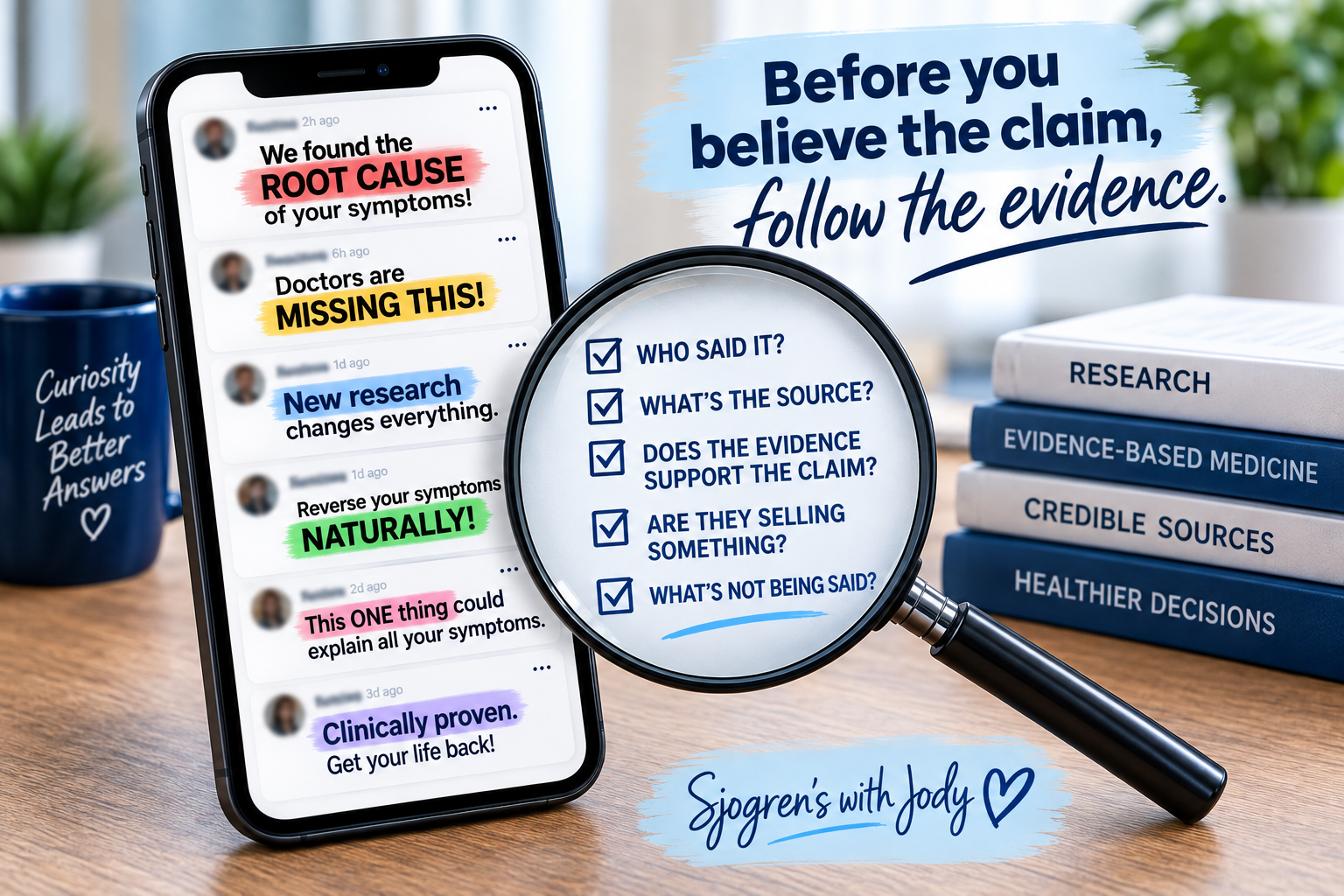
If you live with Sjogren’s disease, another chronic illness, or symptoms that still don’t have an explanation, you’ve probably seen posts like these:
“Your doctor is only treating your symptoms. You need to find the root cause.”
“Doctors are missing the REAL reason you’re sick.”
“This one thing could explain all of your symptoms.”
Those are powerful hooks—especially when you’ve spent months or years searching for answers.
I understand why people stop scrolling.
When you don’t feel well, you want answers. You want someone to connect the dots. And when a health post seems to finally explain why something is happening, it can feel like someone just handed you the missing piece.
But there’s something I’ve started doing when I come across medical information online that sounds especially convincing.
I investigate it.
Sometimes the information checks out.
Sometimes it doesn’t.
And occasionally, I start digging into the research, credentials, or experts mentioned in a post and discover that what looked incredibly credible at first becomes much less convincing once I follow the trail.
That’s why learning how to recognize health misinformation online is so important—especially for people living with chronic illness.
What Is Health Misinformation Online?
Health misinformation is health or medical information that is false, inaccurate, misleading, or missing important context.
What makes it difficult is that it doesn’t always look like health misinformation.
A post may contain medical terminology. It may reference research. Someone may have impressive credentials listed after their name. There may even be links to legitimate scientific studies.
None of that automatically means the conclusion being presented is supported by the evidence.
The National Center for Complementary and Integrative Health, part of the National Institutes of Health, recommends looking at who is responsible for health information, where the information came from, what evidence supports it, and whether the source is trying to sell something.
Those are questions I’ve started asking, too.
Are “Root Cause” Health Claims Reliable?
Let’s talk about the phrase root cause, because it appears constantly in chronic illness content.
Looking for factors that may contribute to symptoms isn’t a bad thing.
Healthcare professionals investigate underlying medical conditions, medication effects, infections, nutritional deficiencies, environmental exposures, sleep problems, other diseases, and many other possibilities depending on someone’s symptoms and medical history.
The problem comes when an extremely complicated medical situation is reduced to one confident statement:
THIS IS THE REASON YOU’RE SICK.
Sjogren’s disease is a good example of why we should be careful with overly simple explanations.
Sjogren’s is a systemic autoimmune disease. People can experience very different symptoms and may also have other medical conditions occurring alongside it.
If someone online claims that every person with Sjogren’s fatigue, pain, brain fog, digestive symptoms, or another symptom has the same “root cause,” I want to see the evidence.
How to Verify a Doctor or Medical Expert Online
I’ve come across health content that references doctors, specialists, or other experts to make a claim appear more authoritative.
So I started looking them up.
You can do the same thing.
If a health post references a doctor or medical expert, search for that person independently.
Can you verify that the person exists?
What are their actual credentials?
Does their area of expertise relate to the topic being discussed?
Can you find the original interview, article, research paper, podcast, or statement where they supposedly made the claim?
Sometimes everything checks out.
Other times, the credentials don’t quite match the impression the post gave you. And if you cannot verify the person or find the original statement at all, that’s worth knowing before allowing the information to influence a healthcare decision.
“Research Shows” — But What Research?
This may be my favorite rabbit hole.
A post says:
“Research shows…”
My next question is:
What research?
If there’s a study linked, I want to know what the researchers actually found.
A real scientific study can be cited in a post that reaches a conclusion the researchers themselves never reached.
Maybe the study involved a small number of participants.
Maybe researchers found an association between two things but didn’t establish that one caused the other.
Maybe the research was conducted in animals or cells and hasn’t been demonstrated in humans.
Maybe the study found something interesting but concluded that additional research was needed.
None of those things mean the study is bad.
They mean it needs to be understood in context.
A citation underneath a health post doesn’t automatically prove everything written above it.
Sometimes you have to click it.
What If the Person Identifying the Problem Is Also Selling the Solution?
Selling a health-related product or service doesn’t automatically make the information surrounding it false.
But financial motivation is something worth considering when evaluating a health claim.
Pay attention to the progression:
First, you’re told conventional medicine has missed the real reason you’re sick.
Then you’re told what your root cause supposedly is.
Finally, you’re offered a supplement, test, program, diet, protocol, membership, or product designed to address it.
That’s when I want more information.
The Federal Trade Commission says health-related advertising claims must be truthful, not misleading, and appropriately supported by evidence.
So don’t automatically dismiss the product.
But don’t automatically believe the claim either.
Follow the evidence.
5 Questions to Ask Before Believing Medical Information Online
You don’t need to become a medical researcher every time you open social media. Start with five questions:
- Who is making the claim?
Can I identify the person or organization, and can I verify their credentials? - Where did the information come from?
Can I find the original research, medical organization, university, government health agency, or other credible source? - Does the source actually support the claim?
A citation is only useful if it says what the person citing it claims it says. - How certain is the language?
Be cautious with words such as always, never, guaranteed, cure, and the real cause when discussing complicated medical conditions. - Is someone selling me the solution?
If so, look for evidence that exists independently of the person or company benefiting financially from the claim.
You Can Question Health Information Without Becoming Afraid of It
I don’t want people living with Sjogren’s disease or chronic illness to become afraid of medical information online.
There is extraordinary information available to us.
We have access to research, medical organizations, patient advocacy groups, physicians, researchers, and educational resources that previous generations could never have accessed so easily.
We should use that access.
And asking questions shouldn’t apply only to social media. It’s reasonable to ask your healthcare team questions, ask where information comes from, and seek clarification when something doesn’t make sense.
The goal isn’t to distrust everyone.
The goal is to become a better consumer of health information.
A professional-looking graphic doesn’t make something true.
A white coat doesn’t make something true.
A doctor’s name doesn’t make something true.
And even a scientific citation doesn’t prove a claim if the research doesn’t actually support what is being said.
So the next time a health post stops you in your tracks—especially one promising to reveal the “root cause” of your symptoms—don’t immediately believe it.
But don’t immediately dismiss it either.
Get curious.
Look up the person.
Find the original source.
Read what the research actually says.
Bring questions to your healthcare team.
And follow the evidence wherever it leads.
That’s what I plan to keep doing here.
Because whenever I see a medical claim that makes me think, Wait… is that actually true?
Jody’s brain is probably about to go down another rabbit hole.
Apparently, it has decided that’s part of the job now.
Finding Health Information Online
When navigating unexplained symptoms or managing a long-term condition, turned-to sources for medical research and guidance matter.
The National Center for Complementary and Integrative Health (NCCIH) offers valuable guidance on evaluating health claims, understanding evidence-based care, and identifying trustworthy online medical content.
In addition, staying informed about product safety, supplement claims, and marketing practices is essential when evaluating treatments.
The Federal Trade Commission (FTC) provides detailed compliance standards and consumer resources regarding health-related advertising and product disclosures.
If you’re trying to organize your symptoms, questions, or appointment information, you can explore my Sjogren’s 101 & Resources here.